

What Kind of Neighbor Should a Retailer Be?
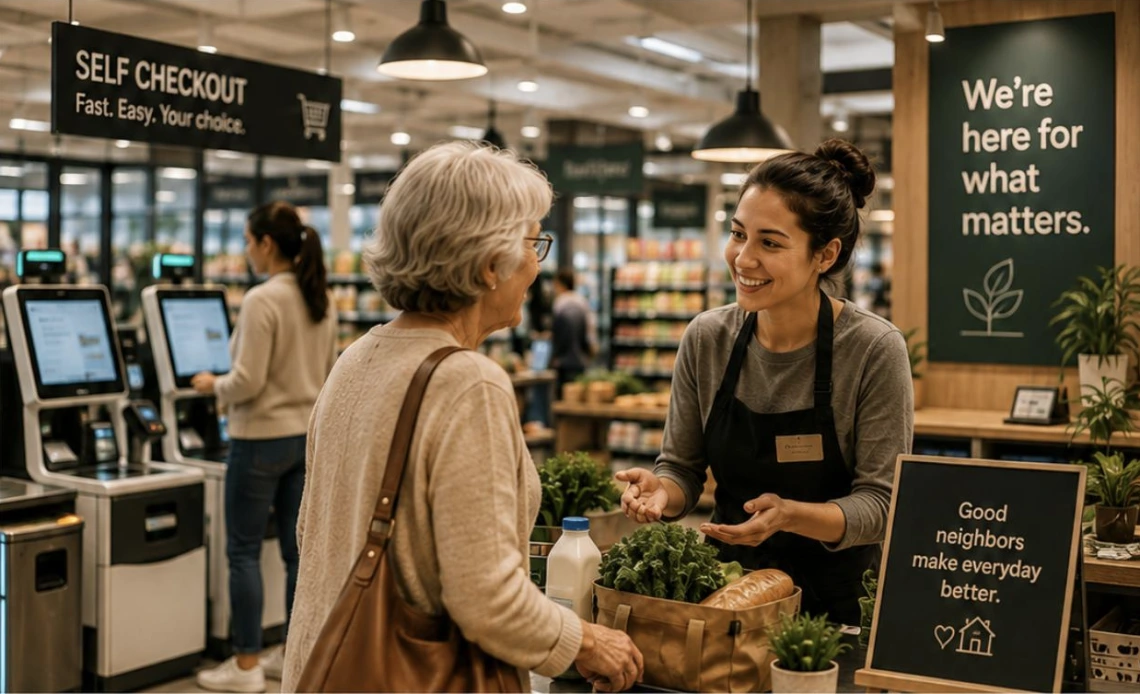
Illustration created with generative AI.
Affordability, Efficiency, and the Human Value of Retail
A small retail story caught my attention some time ago. A gas station offered customers a 20% discount if they were willing to dance in front of others and have the moment captured on video. People danced, others watched and laughed, and the videos eventually reached millions of viewers online. From a marketing perspective, there are familiar explanations, including customer participation, engagement, word of mouth, social media exposure, and experiential marketing. Yet I wondered whether something simpler was happening at the same time. For a few minutes, a retailer had created an enjoyable moment in what otherwise might have been an ordinary day.
The discount itself was meaningful. Twenty percent could represent real savings to a customer and a real cost to the retailer, although the resulting publicity may ultimately have been worth considerably more than the discounts. We should therefore be careful about romanticizing the event as corporate generosity. Still, it left me with a question that has stayed with me: beyond selling products and providing services efficiently, what does it mean for a retailer to behave as a good neighbor?
When the Shopping Location Changes, but the Person Does Not
When household budgets tighten and consumers become more cautious about spending, retail analysis understandably focuses on how they adjust their behavior. They search harder for value, buy more private label, reduce discretionary purchases, postpone purchases, and move toward lower-priced retailers. Concepts such as price sensitivity, value seeking, channel switching, and trading down help us understand these changes economically, but they tell us less about the person making the adjustment.
A parent who changes grocery stores because money is tight may still want to feed the family according to the same values as before. An older shopper watching every dollar still wants to be treated with dignity, while someone worried about housing costs, employment, or the future carries those concerns into the store even though none appears on the receipt. Financial circumstances may change where people shop and what they can afford, but they do not necessarily change the aspirations and concerns consumers bring with them.
Our discussion of economic hardship in retail can therefore become overly focused on its monetary dimensions. Price matters enormously, particularly for financially constrained households, and neighborliness cannot substitute for affordability. Retailers also cannot solve housing costs, employment insecurity, or the other difficulties customers carry into their stores. Yet retailers remain among the everyday institutions people encounter while living through those difficulties.
A retailer can offer competitive prices while also preserving dignity, recognition, and reasonable responsiveness. It can show patience when someone struggles with an unfamiliar system, or allow reasonable flexibility when circumstances interfere with a normal routine. Economic value and relational value can coexist.
What Looks Like a Cost Depends on the Time Horizon
These small moments are not necessarily free. Consider a store associate talking with a customer about what is in the basket or what the customer plans to cook. The conversation is unnecessary for completing the transaction and may add time to checkout. If performance is measured primarily through transactions per hour, waiting time, or labor productivity, the interaction can look like friction that a better-designed system should remove.
The same issue extends beyond conversation. Giving associates more time with customers, providing training, maintaining adequate staffing, or allowing greater discretion can increase operating costs. These are not easy commitments for retailers that are simultaneously trying to protect margins and keep prices affordable. Asking retailers to absorb additional costs simply in the name of being better neighbors would ignore the economic realities under which they operate.
The longer-term question, however, is whether every one of those expenditures should be understood only as a cost. If customers come to believe that a retailer understands their circumstances, treats them with dignity, and responds reasonably when life does not fit the standard process, some expenditures that appear costly in the short run may also contribute to a stronger customer relationship.
This concern is not new to retailing. Scott Kelley's work on service-employee discretion argued more than three decades ago that traditional financial performance measures can encourage short-term thinking and may not adequately capture the value created through discretionary service activities. His broader framework also emphasized that employee discretion depends partly on the organizational environment in which employees work.
Whether the particular form of neighborliness discussed here ultimately produces stronger loyalty, retention, or customer lifetime value (CLV) remains an empirical question. The managerial challenge is not to choose neighborliness over profitability, but to understand when the costs of being a better neighbor may also create durable relationship value, and when they may not.
Recent research provides an interesting illustration. Nanni and Ordanini studied automated digital order screens introduced to make shopping more convenient by allowing customers to continue browsing rather than waiting near a service counter. The technology improved convenience but also reduced opportunities for customers and frontline employees to interact. Across their studies, reduced employee interaction and proactive behavior had negative consequences for customer experience and shopping behavior, while restoring those employee behaviors alongside the technology helped mitigate the effect.
The lesson is not that waiting is good or technology is bad. Customers using technology actually spent less time waiting. Rather, the study demonstrates how removing one form of friction can unintentionally remove something else occurring during that friction. What looked like waiting time was also, in that particular setting, an opportunity for interaction.
Neighborliness Requires an Organizational Foundation
We should not place responsibility for these human moments entirely on frontline associates. Asking employees to be warmer, more patient, and more responsive is relatively easy; creating an organization in which they have the time, authority, and support to behave that way is much harder. An associate working a demanding shift, managing an unpredictable schedule, holding another job, or trying to keep up when staffing is tight may have little time or emotional space for an unhurried interaction.
Nordstrom provides a useful illustration of the broader principle. Its organizational culture has long emphasized an “inverted pyramid,” in which leaders support the employees closest to customers, and the company emphasizes trusting employees to use good judgment in taking care of customers. What another retailer can easily observe is the visible frontline behavior, such as an associate exercising judgment or finding a solution that goes beyond a routine transaction. What is much harder to reproduce is the organizational environment that makes such behavior possible.
Retailer neighborliness therefore cannot be created simply by adding friendliness to an employee script. If retailers want associates to exercise patience, judgment, and reasonable flexibility, the organization itself must support those behaviors. Culture, training, managerial expectations, staffing, workload, incentives, and decision authority operate behind what the customer ultimately experiences.
Neighborliness may therefore be less an individual employee behavior than an organizational capability expressed through frontline encounters.
A Good Neighbor Does Not Have to Be Local
Neighborliness also complicates what we mean by "local." We naturally picture a family-owned store whose owner understands the community and has considerable freedom to make decisions locally. Yet local ownership does not guarantee neighborliness, just as national ownership does not necessarily prevent it.
A national chain can become part of everyday local life when customers repeatedly visit the same location for groceries, prescriptions, and other necessities. Local ownership, local presence, local decision-making authority, and being experienced as a good neighbor are therefore related but distinct characteristics.
What may matter more is the capacity to respond. A store can employ associates and managers who understand local circumstances very well while giving them little authority to act on that understanding. In such cases, the problem is not necessarily a lack of empathy or local knowledge. The organization may simply have left too little room for judgment.
When the Customer Does Not Fit the Process
This issue becomes increasingly important as retail becomes more centralized, standardized, digital, and automated. These developments create substantial value by reducing costs, improving consistency, shortening waiting times, and improving forecasting, inventory management, and customer service. The question is not whether retailers should abandon those advantages, but what happens when a customer's circumstances do not quite fit the process.
Imagine an associate who understands why a particular situation deserves consideration but has to explain that the system does not allow any adjustment. An automated system might reach essentially the same conclusion because the request falls outside its predetermined rules. One interaction involves a human being and the other does not, but both reveal the same organizational limitation: understanding someone's circumstances has little practical value when there is no room to respond.
For that reason, I am reluctant to frame the future of relational retail simply as human interaction versus automation. A human associate without authority, time, or organizational support may be no more responsive than a rigid automated system, while a thoughtfully designed automated process could recognize an exception and connect the customer with someone authorized to consider it.
Recent research on self-service technology adds another dimension. Audrin and Etemad-Sajadi found that consumers valued self-service for the time savings, autonomy, and convenience it provided, but consumers did not all want the same retail experience. Some preferred shopping independently with little interaction, while others valued traditional checkout and the social contact it preserved. Their findings point toward maintaining appropriate human support while recognizing that consumers differ in how they want to participate in self-service.
The goal, then, need not be preserving human interaction at every transaction. Some customers want speed and autonomy, and good retail should respect that preference. The more useful challenge is preserving choice and the capacity for human responsiveness when circumstances require it.
Reasonable responsiveness does not mean granting every request. Retailers need consistency, fairness, safety, and cost discipline, while associates need protection from unreasonable customer demands. Sometimes the appropriate answer is no. The distinction is whether a person's circumstances can enter the decision rather than being excluded automatically because they do not fit the standard process.
What Should the Future of Retail Preserve?
I teach retailing, and much of what I discuss with students concerns merchandising, inventory, pricing, supply chains, productivity, technology, AI, and profitability. Students need those capabilities, and the industry will continue to need them. Another question belongs alongside them: as we teach the next generation to remove friction, optimize processes, standardize operations, and use increasingly capable technologies, what should those systems leave room for?
Consumers do not enter stores simply as transactions waiting to be processed, just as associates bring lives and circumstances of their own to the workplace. When economic pressure increases, consumers may have less room to choose where and how they shop, while some of the people serving them may face similar constraints. At the same time, increasingly standardized retail systems may leave associates, managers, and individual stores with less room to respond.
The challenge is not to resist efficiency, but to recognize that changes designed to improve efficiency can affect more than efficiency alone. A process can become faster while an opportunity for interaction disappears; a standardized rule can improve consistency while reducing room for judgment; automation can give one customer welcome autonomy while leaving another customer needing assistance.
A good retail neighbor does not need to solve people's problems, be locally owned, sacrifice efficiency, or depend on constant human interaction. It may instead be a retailer whose organizational design leaves enough room for customers' circumstances and preferences to be considered, enough room for associates to exercise reasonable judgment, and enough flexibility for technology and people to complement rather than unnecessarily displace one another.
As retail becomes increasingly capable of removing friction, we should ask not only what can be eliminated, but also what is worth preserving.
The answer may tell us what kind of neighbor we want the retailer of the future to be.